The rate beats everyone else's and a friend swears by it. Who is holding your money while it travels?How to check whether a money transfer app or remittance company is legit before you send: licences, registers, and the warning signs no register will show you
Between the moment you pay and the moment your family collects, the money sits with the transfer company. Sometimes that is a few minutes, sometimes two or three days. A polished app, a rate that beats Wise and a cousin who has used it twice tell you nothing about what happens to that money if the company stops answering. What does tell you something is whether a regulator has licensed it to hold other people's money, and you can check that yourself in about ten minutes, before the first dollar leaves your account.
Why a licence matters more than the rate
A money transmitter holds customer funds every day, so in most countries it needs permission to do that, and the permission comes with obligations: keep customer money apart from its own, hold enough capital, know who is sending what, and handle complaints. None of that makes a company perfect. It does mean somebody is watching, and that you have somewhere to take it if a transfer disappears.
An unlicensed operator can undercut everyone precisely because it carries none of those costs. The saving is real until the day it isn't, and on that day there is no regulator to complain to, no receipt the company is obliged to honour, and often no company you could even sue.
Start with the company's legal name, not the app's
Registers list legal entities. The name under the icon on your phone is usually a brand, and searching for it can return nothing even when the business is fully licensed, or return an unrelated firm with a similar name. So before searching anything, find the name the company trades under legally. It tends to appear in three places: the terms of service or legal page on its website, the footer of that site (often a line such as "licensed as a money transmitter by…"), and the seller or developer name on the app store listing. If you already have a transfer receipt, the legal name is normally printed on it too.
Write down that exact name, and any licence or registration numbers the company quotes about itself. A legitimate provider usually publishes them where you can see them. One that makes you dig, or quotes a number without saying which regulator issued it, has already told you something.
Where do you look it up?
Check the register of the country you are sending from, because that is where the company is serving you and where your protections as a customer come from. The payout side in the destination country has its own rules, which matter too, but they don't replace the check at home.
| Sending from | Where to check | What you want to see |
|---|---|---|
| United States | NMLS Consumer Access, which lists state licences | A money transmitter licence for the state you live in, shown as authorised to conduct business |
| United States, federal level | FinCEN MSB Registrant Search | A current registration. Worth seeing, but it is only a filing, not an approval (more below) |
| United Kingdom | FCA Financial Services Register | Authorised or registered as a payment or e-money institution, with the website on the register matching the one you are about to use |
| Canada | FINTRAC's MSB registry | A valid registration under the exact legal name |
| Australia | AUSTRAC's Remittance Sector Register | The business listed as a registered remittance provider |
| European Union | Your national regulator, or the EBA register of payment institutions | An authorised payment or e-money institution, or a registered agent of one |
| Hong Kong | Customs and Excise Department, register of licensed money service operators | A money service operator licence under the legal name, at the address you would visit |
In the US, licensing happens state by state, which catches people out. A company can be licensed in forty states and not in yours. NMLS Consumer Access lets you search by company name or NMLS ID and shows each state licence on its own line, so find your state in particular rather than stopping at the first result that looks reassuring. If the company's own site says it is licensed "nationwide," the register is where you confirm what that means.
Once you have the entry open, four fields do the work: the regulator (the state agency that issued the licence), the licence type (you are looking for a money transmitter licence or your state's equivalent), the status, and a line headed "Authorized to Conduct Business." A licence can still be listed while that last line says no, for instance after it has been suspended or surrendered, so read it rather than assuming that being on the page is enough.
Registered is not the same as licensed
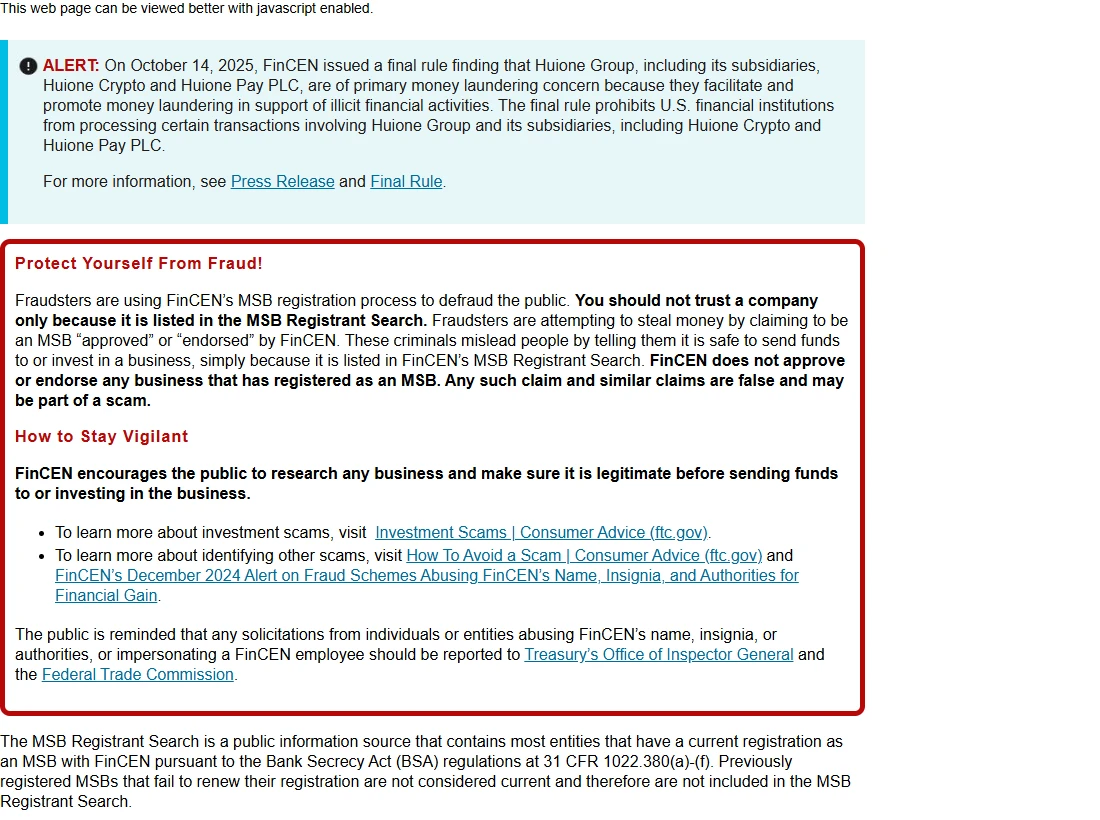
This is the point that trips up the most people in the US. Registering as a Money Services Business with FinCEN is a federal filing that most money transmitters are required to make. It is not a licence, and it involves no judgement about whether the business is sound. FinCEN puts that in a red box at the top of its search page: you should not trust a company only because it is listed there, and FinCEN does not approve or endorse any registered MSB.
Scammers know that "registered with the US Treasury" sounds reassuring, and some will send a screenshot of their FinCEN entry as proof. Treat it as the start of the check. For a US sender, the licence that carries weight is the state money transmitter licence, which typically comes with a surety bond, minimum net worth requirements and regular examinations.
What a licence protects, and what it doesn't
A licence protects you against the company. It doesn't protect you against the person you are paying. If a licensed provider loses your transfer, pays out the wrong amount, or collapses with customer money on its books, there are rules about what happens next and a regulator who cares. If you use the same licensed provider to send money to a stranger who talked you into it, the provider has done its job correctly and the money is, in most cases, simply gone.
That distinction explains a lot of the advice elsewhere on this site. Checking the licence answers "is this company allowed to hold my money?" Checking the recipient, and asking why you are sending in the first place, answers the other half. Most losses in this area involve a genuine, licensed company being used by a fraudster at the other end, which is why the common scam playbooks are worth knowing even when your provider is spotless.
What a register won't tell you
A register confirms that a firm exists and is allowed to operate. It can't confirm that the site or person you are dealing with is really that firm, because a real firm's name and licence number can be borrowed. After the register check, look at how you are being asked to pay.
- You are told to pay into a personal bank account, a crypto wallet or a "local agent" rather than through the company's own app or website.
- The rate is far better than every other provider on the same corridor. Run it through the mid-rate check; a real company has to make its margin somewhere.
- The website or phone number you have been given differs from the one the register lists for that firm. The FCA calls these clone firms: a genuine name and number attached to somebody else's site.
- There is pressure to act today, or a fee to "release" or "unlock" a transfer that is supposedly already on its way.
- You can't find a complaints process, or any address in the country you are sending from.
Your first transfer with a new provider
When the checks come back clean, send a small amount first, one you could shrug off, and pay attention to what the company hands you along the way. In the US, a remittance provider covered by federal rules has to show you the fees, the exchange rate and the amount to be delivered before you pay, and give you a receipt afterwards. You then have up to 30 minutes to cancel at no charge, unless the money has already been picked up or deposited, and 180 days from the promised availability date to report a mistake, which the provider must investigate. The Consumer Financial Protection Bureau sets these rights out on its page on remittance transfers. Very small operators, those making 500 or fewer transfers a year, fall outside those rules altogether, which is one more reason to prefer a provider that is both licensed and established.
A company that skips the disclosure before you pay, can't produce a receipt, or goes quiet when you ask where the money is has failed the test that matters, however smoothly its app runs. Keep the receipt either way. If anything goes wrong later, it is the document everyone will ask for first.
Already sent money through one that doesn't check out?
Stop sending, whatever you are told about the next payment unlocking the last one. Then collect what you have: receipts, screenshots of the quoted rate and of the chat, the account details you paid into, and the dates.
If you paid by card or bank transfer, call your own bank or card issuer straight away and ask whether the payment can be disputed or recalled; the odds fall quickly with every day that passes. Report the company to the regulator whose register it should have appeared on, and in the US to the FTC at reportfraud.ftc.gov. Who to contact for each kind of payment is laid out step by step in money transfer scams and safety.
Common questions
Does being on the FinCEN MSB list mean a transfer company is safe?
No. FinCEN registration is a federal filing, not a licence, and FinCEN states on its search page that it does not approve or endorse any registered business. For a US sender, the check that counts is a state money transmitter licence for your state, which you can look up on NMLS Consumer Access.
How do I find a transfer app's legal company name?
Look at the terms of service or legal page on its website, the site footer, and the seller name on its app store listing. Receipts usually print it as well. Search the register with that legal name rather than the brand.
The app is licensed in another country. Can I still use it safely from here?
A licence somewhere else doesn't cover you where you live. A provider serving customers in your country normally needs permission there too, either a licence of its own or registration as the agent of a licensed firm. If you can't find it on your own country's register in either role, your local protections probably don't apply.
Some apps say they are "powered by" another company. Which one do I check?
Check the company the terms name as the licensed provider. Plenty of smaller apps run as an agent or front end for a licensed partner, which is allowed, but the partner should be named and should appear on the register. If the terms don't say who holds the licence, ask, and treat a vague answer as a no.
Is a small new company riskier than Western Union or a bank?
Size alone doesn't decide it. A young, properly licensed company can be perfectly fine, and an unlicensed one is a risk however long it has been around. Check the licence, send a small amount first, and see how it handles your receipt and your questions.
Where to verify: licensing status goes by each regulator's register at the time you search; the US remittance rights described here are summarised from the Consumer Financial Protection Bureau's public guidance. This article is education, not investment or legal advice.
Published 13 Sep 2026: how to find a transfer company's legal name, which register to check by country, why a FinCEN registration is not a licence, and what to watch on a first transfer.