Money you weren't expecting just landed in your account, and now someone wants it backWhat to do when you receive money from a stranger: why you shouldn't send it back yourself, how a real mistake gets reversed, and what to do if your account is frozen
The text arrives about ten minutes after the payment: "So sorry, I sent you $480 by mistake, it was meant for my landlord. Could you send it back? Here's my other account." You open your banking app and the money really is there. Sending it back feels like the decent thing to do, and it is the one move that costs people the most in this situation. Keep the money untouched, and let the banks move it back.
Where money from a stranger usually comes from
When a payment shows up from someone you don't know, it almost always falls into one of four stories. Only one of them is an honest slip, and on the day it happens you cannot tell which one you are in.
| Where it came from | What happens a few days later | If you sent money "back" |
|---|---|---|
| A genuine typo by the sender | The sender's bank asks your bank to return it | You may be asked to return it a second time, because the bank has no record of your private refund |
| A hacked account or stolen card | The real owner reports the payment as unauthorized and it is pulled out of your account | You lose the full amount you sent, since the incoming money disappears |
| A fake check or overpayment | The check bounces, often weeks after the bank showed the funds as available | You owe the bank the whole check, and the money you sent is gone |
| Money stolen from another victim | Police or the bank trace it and freeze or close the accounts it passed through | You are now part of the chain that laundered it |
In three of the four rows, the payment that reached you gets clawed back and the money you sent does not. That asymmetry is the whole scam: the person on the other end wants your money, sent quickly, while the payment in your account still looks real.
What to do today, in this order
None of these steps require you to work out which story you are in.
- Confirm the payment inside your own banking or payment app. A text message, an email, or a screenshot someone sends you proves nothing.
- Write down the sender's name, the account or username it came from, the date, the amount, and any memo.
- Leave the money alone. Don't spend it, move it, or withdraw it, and don't send part of it anywhere.
- Call your bank on the number printed on your card, or use the support option inside the app, and say you received a payment you don't recognize and someone is asking for it back. Ask them how they want it handled.
- Reply to the sender once, if at all: "I won't touch it. Please ask your bank to reverse it and mine will return it." Then stop engaging.
- Keep every message and the phone number. If the person pushes, threatens, or asks you to send the money somewhere other than the account it came from, report it at ReportFraud.ftc.gov.
Someone who genuinely sent money to the wrong person is usually relieved to hear step five, because a bank reversal is the safest route for them too. A scammer will explain why that won't work: the old account is closed, the bank takes two weeks, rent is due tomorrow. Each new reason is another sign to hang up.
How a genuine mistake actually gets undone
The rule that keeps you safe is short. The money goes back to the account it came from, for the amount that arrived, and a bank moves it.
How that happens depends on how the money reached you. An ACH transfer (direct deposit, most bank-to-bank transfers) can be reversed by the sender's bank: Nacha, which runs the ACH network, lets it reverse an erroneous entry within five banking days of settlement. A wire is harder to pull back, so the sender's bank sends a recall request, and your bank contacts you to ask whether you agree to return it. Saying yes to your own bank, on a call you placed or at a branch, is the right answer. For payment apps, the sender has to go through their own bank or the app. If your app has a refund option on the payment itself, that sends it back to the same account it came from and is fine. Starting a brand-new payment to whatever handle they give you is a different thing entirely.
Any of these lines means the person is not asking for a reversal:
- "My account got closed, send it to this one instead."
- "Just send back the extra, keep what I owed you."
- "Can you pay it back with gift cards, crypto, or a wire?"
- "Don't involve the bank, they'll charge us both."
- A request for a code you just received by text, or to install an app so they can "help you process the refund".
None of this means you get to keep money nobody claims. A bank can take back a payment that was sent in error, and spending it first only means you will owe it later. Calling your bank early also puts on record that you raised the problem yourself.
The check version: "it cleared" doesn't mean it's real
The oldest form of this runs on paper. Someone overpays you with a check, for a used car, a freelance job, a mystery-shopper assignment or a room you're renting out, then asks you to deposit it and wire, send or gift-card the difference back. The FTC's guidance on fake checks describes exactly this, and it leads the page.
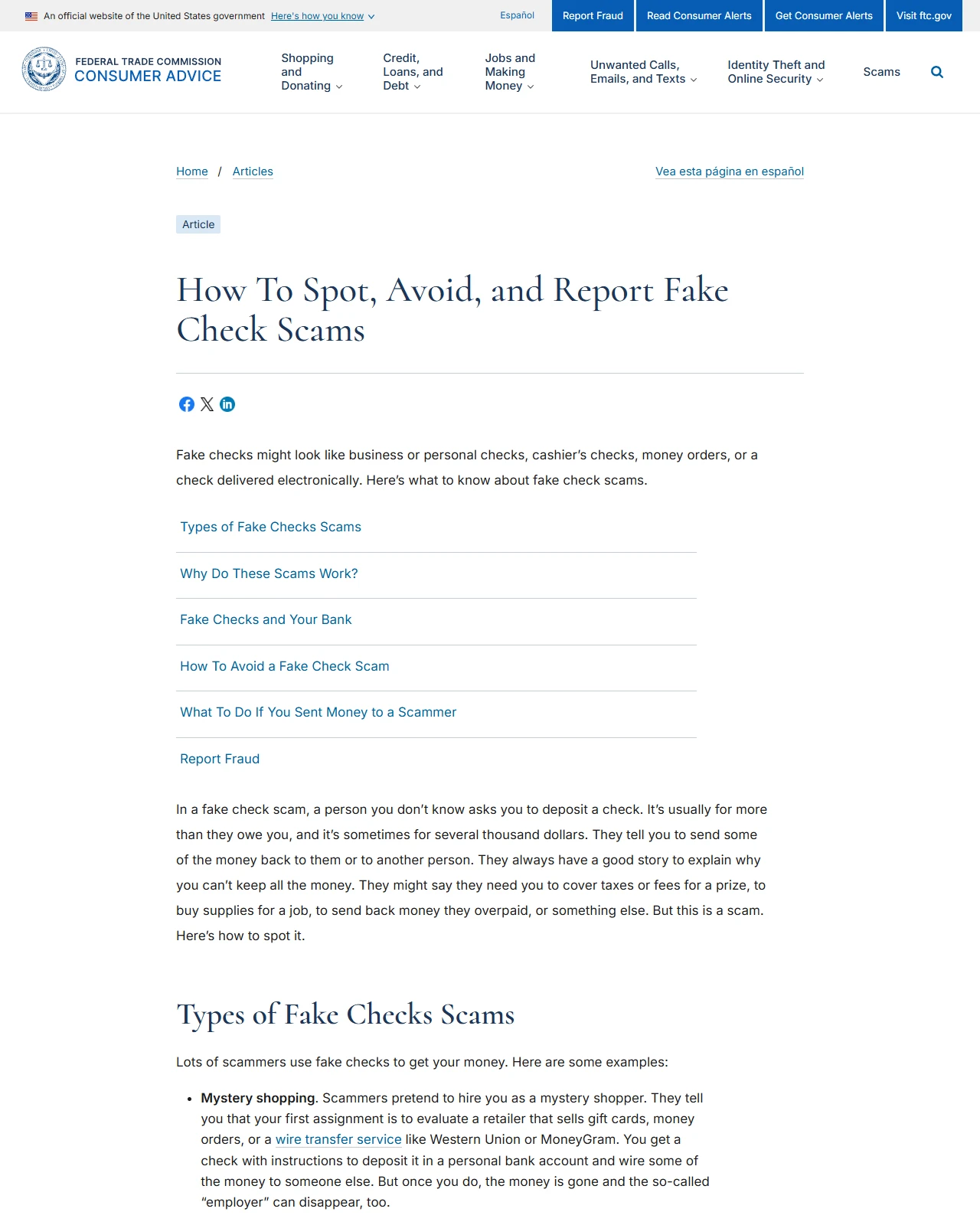
The trap is timing. Banks have to make deposited funds available quickly, usually within a day or two, but it can take weeks for a bad check to come back. Seeing the balance go up only means the bank has fronted you the money; whether the check is good comes out later. When it bounces, the deposit is reversed and you repay the full amount, while whatever you sent out is already gone. If a stranger's check is for more than you're owed, don't deposit it. Ask for the right amount or walk away.
When the "proof" is a SWIFT copy
People who receive money from abroad meet a version with no money at all. A buyer, an online contact, or a "company paying your prize" says they have wired you dollars and sends a formal-looking SWIFT confirmation, sometimes labeled MT103. Then either the transfer is "held at an intermediary bank" until you pay a release, customs or anti-money-laundering fee, or they "sent too much" and need the difference back.
A PDF is not a payment. Only your own bank can tell you whether money is coming in. Ask the sender for the transfer's UETR, the tracking reference every SWIFT payment carries, and ask your bank to look it up. Intermediary banks take their fee out of the transfer itself and never bill the person receiving it, so a request to pay before you can receive is the scam. Our guide to tracing a bank wire covers what to ask your bank for.
If you already sent money back
Move fast rather than blaming yourself. In the first hours, money often still sits in the first account it landed in, and that is when a bank has the best chance of stopping it.
- Call your bank on the number on your card and report the payment you sent as fraud. Give them the amount, the time, and the account or username you paid. If you used a payment app, report it inside the app as well.
- Tell the bank about the incoming payment too. If it gets reversed later, your balance can drop below zero, and it is easier to sort that out now than after the fees start.
- Report it at ReportFraud.ftc.gov, and at ic3.gov if the contact started online. Keep the report numbers; your bank may ask for them.
- If the incoming money might have been a loan or a new account opened in your name, check your credit reports for free at AnnualCreditReport.com, place a free credit freeze with Equifax, Experian and TransUnion, and report identity theft at IdentityTheft.gov, which gives you a recovery plan and a report to send to the lender.
- Keep everything in one place: screenshots of both payments, the messages, the phone numbers, and every report number.
Over the next few weeks, expect offers to "recover your funds" for an upfront fee. They come from the same people or from others who buy lists of recent victims. Hang up.
Why forwarding it can make you a money mule
The Consumer Financial Protection Bureau defines a money mule as someone who receives and moves money that came from victims of fraud. Some know what they're doing. Many don't: they answered a job ad for a "payment processing assistant", helped an online partner who was having trouble with their bank, or sent back a mistaken payment to a new account. The FTC puts it plainly: if someone you don't know sends you money and asks you to forward it, you could be helping a scam.
The consequences land on you, and rarely on whoever set it up. Banks close accounts that were used to move fraud proceeds, you can be asked to repay money that passed through, and the CFPB warns that people who move money for others can lose money or be jailed. If you think you've already been used this way, the FTC's advice is to stop moving money, cut contact, tell your bank and any transfer or gift card company involved, and report it.
If your account gets frozen or closed
Receiving stolen money can get your account restricted even when you did nothing wrong. Call or visit your bank and ask what triggered it, which transactions are involved, and what they need from you. Bring the record you made on day one: when the payment arrived, when you called the bank, the messages asking you to send it back. Having reported it yourself and left the money untouched is the strongest evidence you have.
Ignore anyone who offers to "unfreeze" the account for a fee. If your bank calls you, hang up and call back on the number on your card before you discuss anything. Being asked about a legitimate transfer from family abroad is a different situation, covered in what to do when received money is held.
If you're the one who sent money to the wrong person
Speed matters more than anything else. Call your bank on the number on your card as soon as you notice, give them the amount, the time, and the recipient details you entered, and ask them to recall or reverse it. For an international wire, give them the UETR as well. Once a wire has been credited, getting it back depends on the recipient agreeing, so every hour counts. Most payment apps can't cancel a payment once the recipient has it, so contact your bank or the app straight away anyway and let them contact the other side.
Don't chase the recipient yourself, and don't pay anyone who offers to recover the money for a fee. The FTC's page on refund and recovery scams warns that these "recovery" services target people who have just lost money. The step-by-step for after a scam is in our money transfer scams guide.
Common questions
Can I keep money someone sent me by mistake?
No. The sender's bank can ask for it back, and if you've spent it you'll owe it. Tell your bank, leave the money where it is, and let it be returned through the bank to the account it came from.
The sender says their account was closed and asks me to send it to a different one. What should I do?
Decline. A reversal goes back to the account the money came from, handled by the banks. A request to pay a new account is the clearest sign of a scam in this whole situation.
Someone sent me money on a payment app and asked for it back. Is using the app's refund button safe?
A refund option attached to that payment sends it back to the same account, which is fine. Sending a new payment to a username they give you is not. If the incoming payment came from a stolen account, it can still be reversed later, so check with the app or your bank first.
I deposited a check from someone who overpaid me and the money shows as available. Can I send back the difference?
Don't. Available funds don't mean the check is good; fake checks can take weeks to bounce, and you'd repay the full amount. Ask your bank whether the check has actually been paid by the bank it was drawn on, and don't send anything until you know.
I already sent the money back to them. Is it gone?
Not necessarily, but speed decides it. Call your bank now and report the payment as fraud, report it to the FTC, and leave the incoming payment untouched until your bank tells you what happens to it. If a loan or account in your name may be involved, freeze your credit as well.
Where do I report it?
Report to the FTC at ReportFraud.ftc.gov, and tell your bank and any app or transfer company involved. If the contact started online, you can also file with the FBI's Internet Crime Complaint Center at ic3.gov.
Facts checked September 2026 against the FTC's consumer guidance on fake checks and money mules, the CFPB's explainer on money mules, and Nacha's rules for reversing ACH entries. This is general information, not legal advice; your bank's process decides how a specific payment is handled.
First published 21 Sep 2026: what to do with money from a stranger, how genuine mistakes are reversed, fake check and fake SWIFT variants, what to do if you already sent money back, and what to do if you're the one who sent money to the wrong account.