Can you reverse a bank transfer? How to get money back from the wrong account or a scammerHow to recall a bank transfer, wire, Zelle payment or international transfer, the deadlines in the US, UK and EU, and what to do if the bank says no
You press send, and a second later you see it: one digit wrong in the account number. Or the "bank fraud team" that told you to move your savings into a safe account has stopped picking up. Either way, the next hour counts for more than anything you do after it. Some payments can still be stopped, some can be pulled back only if the person on the other end agrees, and a few can't be reversed at all. In several countries the rules also give you a way to claim the money when the bank can't recall it.
Sent money to the wrong account? What to do in the first hour
- Call your bank on the number printed on your card or shown in its app, never a number from a text or email. Say straight away whether this was a mistake or a scam, because the two go through different processes.
- Give them the amount, the date and time, the account number or username you paid, and the payment reference. For an international wire, ask for the UETR, the tracking number every SWIFT payment carries.
- Ask in plain words for the payment to be stopped, recalled or reversed, and write down the case number and the name of the person you spoke to.
- If you were scammed, report it the same day: in the US at ic3.gov and ReportFraud.ftc.gov, in the UK to Report Fraud on 0300 123 2040. Banks move faster when you can give them a report number.
- Don't try to negotiate with the recipient, and don't pay anyone who offers to recover the money for a fee.
- Put the payment screenshot, the messages and the phone numbers in one folder. Every later step asks for them.
Can a bank transfer be reversed? It depends on how you paid
What decides it is who controls the money right now. Before it reaches the other account, your own bank or provider can often stop it. After it lands, someone else has to cooperate.
| How you paid | Can it be stopped or recalled? | The time that matters |
|---|---|---|
| US bank transfer (ACH) | Your bank can reverse it, but only for an error such as a wrong account, a wrong amount or a duplicate | Within 5 banking days of settlement, under Nacha's rules |
| Wire, domestic or international | Your bank sends a recall request; once the money is credited, the recipient's bank usually needs the recipient's consent | Hours. For fraud, the FBI has the best results when it hears within 72 hours |
| Zelle | Only cancellable if the recipient hasn't enrolled yet; otherwise the payment is final | Report impostor scams to your bank at once |
| International transfer sent from the US by a transfer company or bank | Cancel for a full refund if the money hasn't been picked up or deposited | 30 minutes after paying; errors can be reported for 180 days |
| UK bank transfer | Wrong account: the Credit Payment Recovery process. Scam: mandatory reimbursement | Bank starts within 2 working days; scam claims within 13 months, up to £85,000 |
| Euro transfer (SEPA) | Your bank can send a recall; money comes back if it's still there and the recipient agrees | About 10 banking days for mistakes, up to 13 months for fraud |
| Card payment | Dispute it with the card issuer (a chargeback), which doesn't need the merchant's agreement | Ask the issuer for its deadline |
| Crypto | Can't be reversed on the blockchain | Only an exchange still holding the coins can freeze them, so contact it at once |
The windows in the table are the ones set by each set of rules, checked in October 2026. Your bank may act faster, and it won't act at all until you call.
How to get money back after paying the wrong account
A mistake is the easier case, because nobody is racing to move the money on. Your bank still can't take money out of somebody else's account by itself. What it can do is contact the recipient's bank, which can hold what is still there and ask its customer to agree to send it back. How much help you get depends on where you are.
- In the US. An ACH payment sent in error can be reversed by your bank within five banking days of settlement. After that, and for wires, it becomes a request to the receiving bank, so call the same day. A Zelle payment to someone already enrolled can't be cancelled by Zelle, but your bank can still contact the recipient's bank.
- In the UK. Banks follow the Credit Payment Recovery process. Once you report the mistake, your bank must start within two working days, and if the recipient doesn't object you should get the money back within 20 working days. If the recipient refuses, regulation 90 of the Payment Services Regulations 2017 requires your bank, when you ask in writing, to give you the information you need to claim the money from them directly.
- In the euro area. Your bank can send a SEPA recall to the recipient's bank. That bank replies, and the money returns only if it is still in the account and the recipient agrees, so a recall sent the same day has the best chance.
- Anywhere else. Ask your bank to contact the receiving bank, get its answer in writing, and keep the payment record.
If the recipient refuses, or has already spent it, the money is still owed to you: a payment made by mistake gives you a claim against the person who received it. For modest amounts a small claims court is usually the cheapest way to pursue it. If a stranger contacts you saying they are the recipient and asks for a "release fee" before returning it, that is a scam. Real returns go back through the banks and cost you nothing.
Sent money to a scammer? How to get it back
Use the word fraud when you call. A payment you made yourself to someone who lied to you is called authorised push payment fraud in the UK and an impostor scam in the US, and banks handle it differently from a typo. Here the order is report first, then chase, because someone on the other side is moving the money on.
- In the UK. Since 7 October 2024, banks and payment firms must reimburse victims of authorised push payment fraud on Faster Payments and CHAPS, up to £85,000 per claim, as long as you claim within 13 months of the last payment. Most claims are settled within five business days. There are exceptions, so ask your bank to put its decision and the reason in writing.
- In the US. There is no general reimbursement rule for payments you authorised. If the scammer pretended to be your bank, a government agency or Zelle, report it to your bank: since June 2023, banks on the Zelle network have reimbursed qualifying impostor scams. For a wire, ask your bank to recall it and file at ic3.gov the same day. The FBI's Recovery Asset Team works with banks to freeze money that is still there, and international wires reported within 72 hours have the best chance.
- Anywhere else. Report it to the local police, online if they offer it, get a report number, and give that number to your bank.
- By card. If you paid with a credit or debit card, dispute the charge with the card issuer. A chargeback doesn't need the merchant to agree.
- In crypto. A blockchain transfer can't be undone. If the coins went to an account at an exchange, send that exchange the transaction hash and the receiving address and report it to the police right away; the exchange can freeze what it still holds.
Over the following weeks you may hear from "recovery agents", "lawyers" or "government refund units" offering to get the money back for a fee. The FTC warns that these refund and recovery scams target people who have just lost money. Real recovery goes through your bank, your card issuer or the police, and none of them charge you upfront. What to watch for afterwards is covered in our scams guide.
Can you cancel an international money transfer? The 30-minute rule
If you sent money from the US to another country through a money transfer company, an app or your bank, federal remittance rules give you two specific rights. The Consumer Financial Protection Bureau sets them out on its page for people having trouble sending money abroad.
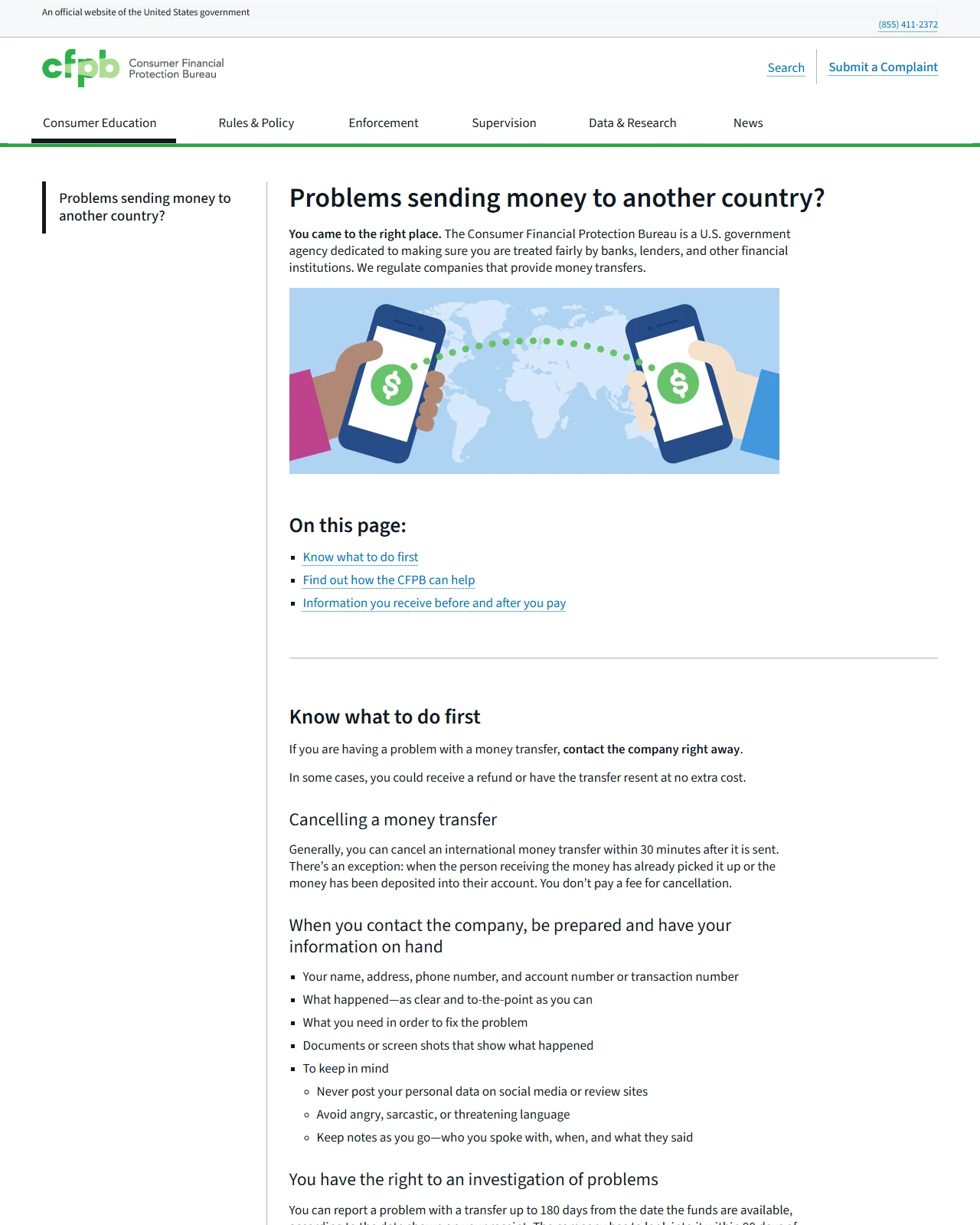
- Cancel within 30 minutes of paying and get everything back, fees included, as long as the money hasn't been picked up or deposited. Do it in the app or by calling the provider, and save the confirmation.
- Report an error within 180 days of the date the money was due to be available. The provider has to look into it within 90 days and tell you the result; depending on what went wrong, you may get a refund or have the transfer sent again.
A wrong account number can count as an error the provider has to investigate, so report it even after the 30 minutes have passed. For an international bank wire sent from anywhere, ask your bank to send a recall through SWIFT and to give you the UETR so you can follow it. Our guide to tracing a bank wire lists what to ask for.
What if the bank can't get your money back?
- Ask for the answer in writing, with the reason. If you disagree, tell the bank you are making a formal complaint and note the complaint reference it gives you.
- In the US, file a complaint with the CFPB at consumerfinance.gov/complaint. In the UK, if the bank rejects your complaint or hasn't replied within eight weeks, take it to the Financial Ombudsman Service, which is free. In the EU and elsewhere, take a rejected complaint to your country's financial or banking ombudsman, or the consumer complaints service of your financial regulator.
- If you know who received a mistaken payment and they won't return it, consider a small claims case, using the information your bank gave you.
- Keep every reference: police or fraud report numbers, the bank's case number, complaint numbers. Reimbursement teams, ombudsmen and courts all ask for them.
How to avoid sending money to the wrong account
- Read the name check. UK banks show a Confirmation of Payee result, and since 9 October 2025 banks in the euro area run Verification of Payee before you pay. If it says the name doesn't match, stop and confirm the details by phone.
- Send a small test first to a new payee, or before a large amount, and wait for the recipient to confirm it arrived.
- Pay from a saved payee instead of typing the account number again.
- Choose a slower option when it isn't urgent. A payment that hasn't settled yet is the easiest one to stop.
- Treat urgency as a warning. "Move it to a safe account" or "pay now or it will be frozen" is how authorised push payment scams start. The pre-send checklist has the full list to run before you pay.
Common questions
Can a bank transfer be reversed after it's sent?
Sometimes. A US ACH transfer can be reversed by your bank for errors within five banking days, a UK payment to the wrong account goes through the Credit Payment Recovery process, and a euro transfer can be recalled. Once money is credited, it usually comes back only if the recipient's bank still holds it and the recipient agrees, so call your bank as soon as you notice.
How long do I have to recall a bank transfer?
Treat it as hours, not days. The formal windows are five banking days for a US ACH error, about 10 banking days for a euro recall, 30 minutes to cancel an international transfer sent from the US through a money transfer company, and 13 months to claim a UK scam reimbursement. The sooner you call, the more likely the money is still in the first account it reached.
Can I get my money back if I sent it to a scammer?
Possibly. In the UK, most bank transfer scams are reimbursed up to £85,000 if you claim within 13 months. In the US, report it to your bank, at ic3.gov and at ReportFraud.ftc.gov the same day; banks on the Zelle network reimburse qualifying impostor scams, and a wire can sometimes be frozen if it is reported quickly. Card payments can be disputed with the card issuer.
Can the bank force the person to give my money back?
No. The bank can freeze what is left and ask, but the recipient has to agree. If they refuse, you have a claim against them for money paid by mistake. In the UK your bank must give you the information you need to pursue it, and a small claims court is the usual route for modest amounts.
Can I cancel a Zelle payment?
Only if the recipient hasn't enrolled in Zelle yet. Once they have, the payment is final. If you were tricked by someone pretending to be your bank, a government agency or Zelle, report it to your bank, which may reimburse it.
Can a crypto transfer be reversed?
No, not on the blockchain. If the coins went to an account at an exchange, report the transaction hash and address to that exchange and to the police straight away, because the exchange can freeze funds it still holds.
Facts checked October 2026 against the CFPB's guidance on sending money abroad, Nacha's rules on reversing ACH entries, the UK Payment Systems Regulator's reimbursement rules and the Payment Services Regulations 2017, the European Payments Council's SEPA rules, and FBI IC3 guidance on wire fraud. This is general information, not legal advice; your bank's process decides how a specific payment is handled.
First published 6 Oct 2026: what to do in the first hour, which payment types can be recalled and by when, mistaken payments versus scams, the 30-minute and 180-day rights for transfers sent abroad from the US, and where to escalate.