Can you receive money from abroad on a debit card? How international card deposits workWhich transfer services pay straight to a Visa or Mastercard debit card, what the sender needs from you, how fast it lands, and why a card deposit gets refused
Yes. In many countries someone abroad can send money straight to your Visa or Mastercard debit card using little more than the 16-digit number on the front and your name as it appears on the card. Western Union, Remitly, MoneyGram, Xoom and Wise all offer a version of it, and it often lands within minutes. Whether it works for you comes down to two things: the sender's service has to offer card deposit to your country, and your bank has to accept incoming card payments on that card. The money doesn't sit on the card itself. It goes into the bank account the card is linked to, so you can spend it with the card or move it like any other balance.
Which services can send money to a debit card internationally?
These are the routes we found on each provider's own pages in October 2026. Country lists change and depend on where the sender is, so use this as a starting point rather than a complete list.
| Service | Cards it pays to | Destinations it lists | Speed it states |
|---|---|---|---|
| Western Union, sending from the US | Visa debit | Philippines, Jamaica, Thailand, Colombia, El Salvador | "In as little as 30 minutes", not guaranteed |
| Western Union, sending from France | Mastercard debit | Croatia, Kosovo, Romania, Serbia, Slovakia, Hungary, Turkey, Ukraine and more | Typically 30 minutes, varies by the receiving bank |
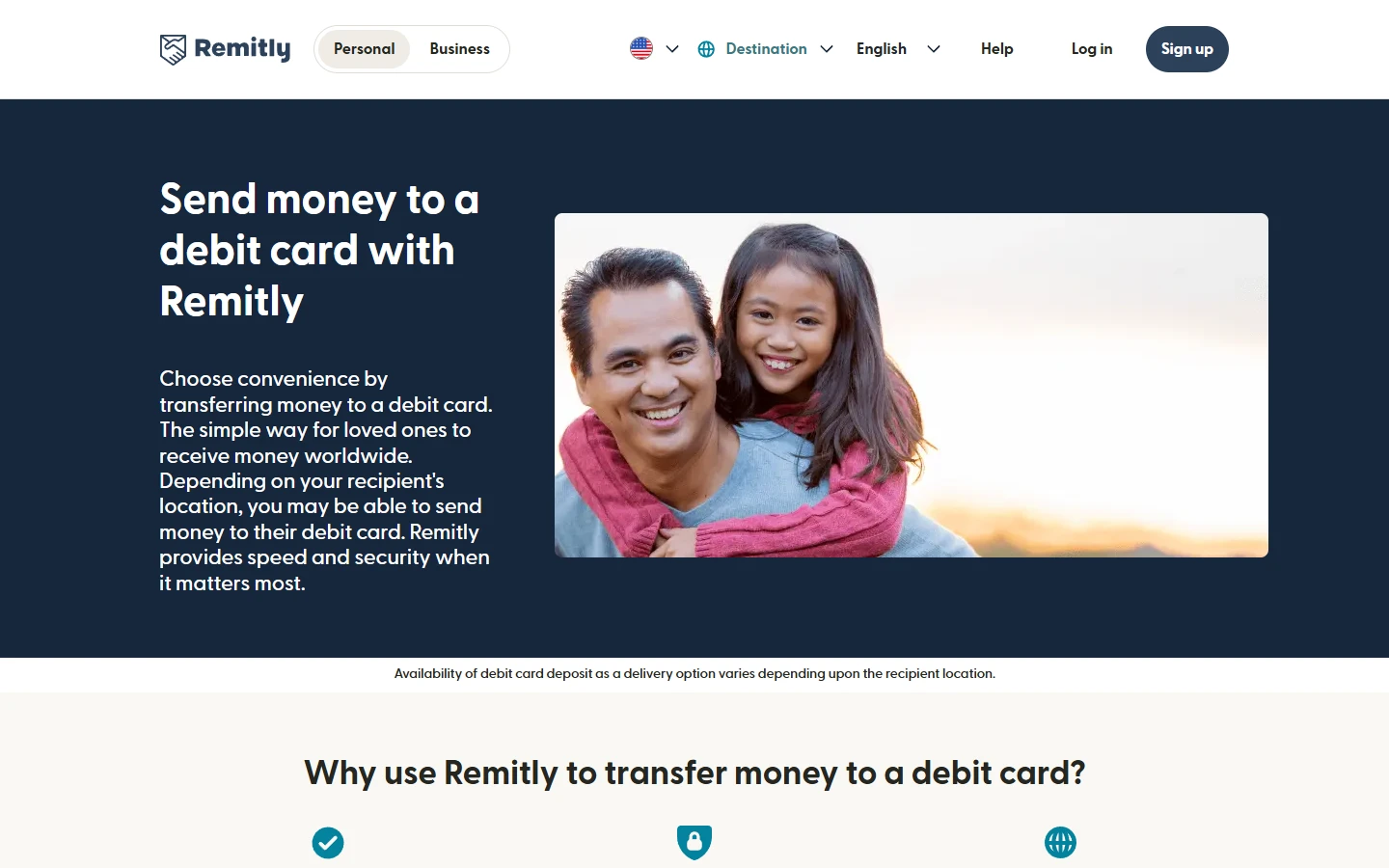
| Remitly | Visa or Mastercard debit from a bank that supports debit card deposits | Depends on the recipient's country (Jamaica and the Philippines among them) | No time given |
| MoneyGram | Eligible bank-issued debit card ("Debit Card Deposit") | Eligible countries only | Depends on country, bank hours and checks |
| Xoom (PayPal) | Visa and Mastercard debit, US senders only | Philippines, Ukraine and others | "Typically deposited in minutes" |
| Wise | Debit cards in specific currencies only, such as Mexican debit cards and UnionPay cards in China | Mexico, mainland China | Mexico: usually instant. China: usually the same working day |
Behind most of these sits a card network's push payment, Visa Direct or Mastercard's equivalent. Visa describes it as moving money "domestically and across borders" to eligible cards, and adds in a footnote that when the money becomes available "may depend on receiving financial institution". That footnote is why every provider hedges on timing.
Which cards can receive money, and can a credit card?
A debit card issued by a bank and linked to a current or checking account is what every one of these services is built for. The providers word it almost the same way: Remitly asks for a debit card "issued by a bank that supports debit card deposits", and MoneyGram and Xoom ask for an eligible bank-issued debit card.
- Prepaid and virtual cards. None of the pages we read rules them out in so many words, but the "bank-issued" wording points that way, and our reading is that they are refused more often than ordinary debit cards. If a prepaid card is all you have, ask the sender to try a small amount first.
- Credit cards. A few services accept them. Western Union's German site says senders can pay to a receiver's credit card, with the money going to the account behind the card. Most remittance services only take debit cards. On a credit card the money normally just reduces what you owe, and many issuers treat taking it back out as cash like a cash advance, with its own fee. Ask your card issuer before you rely on it.
- A debit card from your own bank can still be refused if the bank hasn't opened that card to incoming payments. You won't see this anywhere on the card. Ask the bank whether it accepts Visa Direct or Mastercard Send payments, or have the sender try a small amount.
What do you need to give someone to send money to your debit card?
- Your full name exactly as it's printed on the front of the card. Western Union says the name and card number must match the card.
- The 16-digit card number. Copy it from the card or your banking app instead of typing it from memory.
- Your country, and for some services your mobile number and address. MoneyGram also asks the sender for the card's expiry date. In some countries it can text you a link instead so you type the card details in yourself, which is the better choice when it's offered.
Never give the security code on the back of the card, your PIN, a one-time code from a text message or your online banking password. None of the services above needs any of them to pay you, and someone who asks for them is trying to take money, not send it. Giving your card number to a relative or a client you know is a normal part of being paid this way. A stranger who says they need it to "refund" you is a different story; that pattern is covered in our guide to money someone sent you by mistake.
How long does it take to receive money on a debit card?
Usually minutes. Western Union quotes "as little as 30 minutes" from the US and "typically 30 minutes" from France, Xoom says deposits typically arrive in minutes, and Wise says transfers to Mexican debit cards usually arrive instantly. Visa told US banks in 2016 to make these funds available within 30 minutes of approving them, but that rule is for US card issuers. Elsewhere your own bank sets the pace.
What slows a card deposit down is rarely the card network. The sender's service may hold the transfer to check their identity or where the money came from, especially on a first transfer or a larger amount, and Remitly says it may ask for extra documents depending on the amount. Your bank may also post the money a little later than the app marks it as delivered. If the sender's app says "delivered" and nothing shows after a few hours, ask your bank to look for an incoming card credit, not an incoming transfer.
Why was a card deposit refused, or shown as unavailable?
| What you see | Most likely reason | What to do |
|---|---|---|
| Refused straight away | The card isn't eligible: prepaid, credit, a card your bank hasn't opened to incoming payments, or a bank the service doesn't support | Give a different debit card, or ask the sender to switch to bank deposit |
| Sent back after a while | The name doesn't match the card, or a digit is wrong | Check the name letter by letter against the card; the sender can usually correct it and retry |
| Card deposit missing from the app, or "temporarily unavailable" | Not offered right now for that country, sending country or amount | Use bank deposit or a mobile wallet instead |
| "On hold" | The provider is checking the sender's identity or the reason for the payment | The sender answers the provider's request; nothing on your side speeds it up |
Remitly doesn't explain its "temporarily unavailable" message on its help pages. Our reading is that the route to your bank or country is switched off for now, and the practical answer is the same either way: pick another delivery method. When a card deposit is refused, the money goes back to the sender's provider, which either lets the sender change the details or refunds them. Remitly, for example, lets the sender edit the recipient's details on a held transfer and then retries delivery.
Card deposit or bank deposit: which is better?
Card deposit wins on speed and on what the sender has to type: a card number and a name, instead of an account number, a SWIFT code and a bank address. Bank deposit tends to win on how much you can receive in one go and on the paper trail, and on some routes on price. Fees and the exchange rate are set separately for each route and payout method, so the only fair comparison is for the sender to start the same amount both ways in the same app and compare the "recipient gets" figure. Our remittance take-home calculator shows how a small rate markup changes what arrives.
If the sender is in the US and uses a licensed transfer company, a card deposit is covered by the same federal remittance rules as any other transfer: a receipt showing the rate and fees, 30 minutes to cancel, and 180 days to report an error, according to the Consumer Financial Protection Bureau. Those rights belong to the sender, so if something goes wrong it's the sender who raises it with the provider.
Receiving on a UnionPay card in China
In mainland China the card route is UnionPay, not Visa or Mastercard. Wise sends yuan to UnionPay cards linked to a CNY bank account. Its limits are CNY 33,000 per transfer, USD 10,000 per recipient per day and USD 50,000 per recipient per year, and the yearly figure counts money arriving from other services too. You can receive at most 5 transfers a day and 20 a month. The money usually arrives the same working day. The recipient's name has to be in Latin letters, the payment has to be personal rather than for goods or a business, and some banks, including China Merchants Bank and Bank of Nanjing, don't accept these payments. Alipay and WeChat are the other quick routes; both are covered in how to send money to China.
What if card deposit isn't offered in your country?
A bank deposit to your account works almost everywhere. The sender needs your name as the bank holds it, your account number (an IBAN in Europe and many other countries) and your bank's SWIFT code. Where mobile money is common, as in much of Africa and parts of Asia, a transfer to a mobile wallet is often quicker than either. Cash pickup is the fallback when you have no account at all. Our guide to receiving money from abroad covers all four, with the exact details to give the sender for each.
Common questions
Can I receive money on my debit card from another country?
Yes, if the sender's service offers debit card deposit to your country and your bank accepts incoming card payments on that card. Western Union, Remitly, MoneyGram, Xoom and Wise all offer it on some routes. The money goes into the bank account linked to the card.
What does someone need to send money to my debit card?
Your full name exactly as printed on the card and the 16-digit card number, plus your country. Some services also ask for your phone number and address, and MoneyGram asks for the card's expiry date. Nobody needs the security code on the back, your PIN or a one-time code.
How long does it take to receive money on a debit card?
Usually minutes. Western Union says as little as 30 minutes and Xoom says deposits typically arrive in minutes, but your bank decides when the money becomes available, and an identity check by the sender's provider can add a delay.
Can I receive money on a prepaid card or a credit card?
Sometimes, but don't count on it. Most services ask for a debit card issued by a bank. Western Union's German site does let senders pay to a credit card, but there the money normally just reduces what you owe. If a prepaid card is all you have, ask the sender to try a small amount first.
Is it safe to give someone my debit card number?
Giving the number to a relative or client you know so they can pay you is normal. Never give the security code, your PIN, a one-time code or your online banking password. Someone who asks for those is not trying to pay you.
How much does PayPal charge to move money to a debit card?
In the US, an instant transfer from your PayPal balance to a debit card or bank account costs 1.75% of the amount, with a minimum of $0.25 and a maximum of $25. A standard transfer to your bank is free when no currency conversion is involved.
Information checked 29 October 2026 against Western Union's US, French and German pages on sending to cards, Remitly's debit card deposit pages, MoneyGram's help centre, Xoom's country pages, Wise's guides to MXN transfers and to UnionPay transfers, Visa's Visa Direct product and developer pages and its 2016 announcement on fund availability, Mastercard's developer documentation for Mastercard Send, the Consumer Financial Protection Bureau's explainer on remittance transfers, and PayPal's US consumer fees page. Destinations and limits change; check what the app offers when the transfer is set up.
29 Oct 2026, first published: which services pay to a debit card, which cards can receive, what to give the sender, how long it takes, why card deposits fail, card versus bank deposit, UnionPay cards in China, and what to do where card deposit isn't offered.